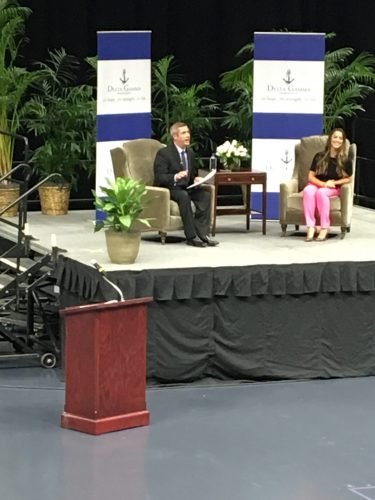
Takeaways from Aly Raisman Event at LSU
Last night I had the opportunity to attend an event on the campus of LSU and hear Aly Raisman, Olympic gold medalist, and sexual abuse survivor, share her story with students. I wanted to recap some of what she had to say as a survivor in the spotlight, both because of her athletic fame, but also because of her strength in facing Larry Nasser in court and making the statement that she did. I am going to focus in on a few things that she said that I found interesting, by way of tweets that were shared during the event, by myself and others:
.@Aly_Raisman: it’s okay not to be okay. Raisman urges anyone struggling in silence to ask for help, and not be ashamed by what happened to them. For friends/family, be supportive even if you can’t relate to their experience. #AllinforAly
— Katie Gagliano (@katie_gagliano) April 12, 2018
“You’re not alone, and it’s ok to ask for help, even on social media” – Aly Raisman #allinforaly
— Child Abuse Survivor (@SurvivorNetwork) April 12, 2018
I thought this topic, right off the bat, was an important one. Aly talked about the #MeToo movement, and also mentioned male survivors of abuse, but reminded us that there are still so many people out there who remain uneducated about it. They don’t realize how common it is, and they look at social media, see all these “perfect” lives of people having fun and it only serves to make them feel worse about themselves. It’s OK to not be OK. It’s OK to need help. She even talked about how it was OK for herself to have bad days. To have days where she isn’t strong. To take time for herself, and to ask for help. It’s OK to be honest and public about that fact too.
On being an advocate –
On her time in court @Aly_Raisman – I was strong for 12-13 minutes. That’s not my every day life. It took a lot out of me but it was important.
— Child Abuse Survivor (@SurvivorNetwork) April 12, 2018
On people who think people tell #sexualassault stories for attention:
“If you think that, you need to educate yourself” –@Aly_Raisman. She says it’s not enjoyable to talk about, but it’s necessary #AllInForAly #LSU— Andrea Gallo (@aegallo) April 12, 2018
“I’ve been speaking out about this for awhile, and I need to find balance, take care of myself and not burn out”. Good reminder for advocates from @Aly_Raisman
— Child Abuse Survivor (@SurvivorNetwork) April 12, 2018
Aly being honest about how difficult it is to talk about sexual abuse, to tell our stories, and to advocate is was very refreshing to me. I see it all the time on social media, and even from readers here. We all need to take the time and find a balance. This is hard work. Telling your story to anyone, let alone crowds of people you have never met before, takes a lot of emotional energy. If you aren’t replenishing that, you will burn out. That is 100% the truth.
It’s also why we can’t sit back and leave it to the world class athletes, and music stars to tell these stories. Even someone as strong as Aly needs to be able to take a break, and take care of herself. There need to be more people willing to step up and share their stories too, on whatever platform they may have.
The very first audience question was by someone who was glad to see some men in attendance, but also couldn’t help but notice that the 1,000 or so people there were largely female, and asked about getting more men involved. I appreciated Aly’s response because she didn’t just talk about men’s role is sexual assault on campus, which is a reality and important, but she also talked about giving male survivors the space to talk without fear of being mocked. This is so important. I was very glad to not be the only male there myself, but this topic was a stark reminder that we don’t have enough men willing to share their stories. We, especially, cannot leave it to someone like Aly Raisman to tell our stories. We need men, of all ages, races and backgrounds to share their stories, and make sure that male survivors know that they are not alone too.
.@Aly_Raisman notes that 1 in 6 boys experience sexual abuse before they are 18 years old, says society should make them feel more comfortable with coming forward. #AllinforAly #DGLSU pic.twitter.com/cJNTniN7Yv
— Caitie Burkes (@caitie1221) April 12, 2018
Lastly, this little fact makes my blood boil.
Aly Raisman reiterates importance of education about #sexualassault & high rates of children who are molested. She said she thought what #LarryNassar was doing was OK for the longest time bc she’d been taught it’s OK for doctors to touch you “in private parts” #AllInForAly
— Andrea Gallo (@aegallo) April 12, 2018
I do not believe anyone can stress this enough. Talk.To.Your.Kids!!
She told this story in response to a father who asked about protecting his kids from abuse. The red flags that were missed in her case were many, and it could go on freely because no one had told her that it was not OK for any adult, even a doctor, to touch her. She was a kid focused on her gymnastics, who hadn’t been warned that there were bad adults in the world.
We have to make sure kids not only understand that reality, but also understand what’s private on their bodies, and that they can, and should, tell people when someone, anyone, does something that makes them uncomfortable, or tries to be alone with them. We can’t be so afraid of ruining their “innocence” that they wind up being another statistic instead. It’s on us, parents, and all of us who care about children, to make sure that they can come forward anytime and that they will be safe, and believed, when they do. Every time we fall short of that, we fail our children.
We cannot let our awkwardness with the topic, or our blind ambition for the Olympic glory of our kids, blind us to the fact that sexual abuse is much more common than we think, and it can absolutely happen to anyone.
“No one thinks sexual abuse is common or will happen to them, until it does.” #AllinforAly
— Child Abuse Survivor (@SurvivorNetwork) April 12, 2018