Unpopular Opinion, The Kids Online Safety Act is Going to Harm More Kids than it ProtectsPin
|

Unpopular Opinion, The Kids Online Safety Act is Going to Harm More Kids than it Protects

If you’ve not heard about the Kids Online Safety Act, there’s a good rundown of why it’s not what most people think it is on Techdirt.

Senator Blumenthal Pretends To Fix KOSA; It’s A Lie

There are two things in all of these proposals to “make the internet safe for kids” that only worsen things for many kids and adults.

  1. First, any identity verification system for adults will end with identities stolen and people’s internet usage tracked by malicious actors. Having to prove your identity before you access most parts of the internet is unacceptable. It’s a violation of privacy and free speech, which includes the right to speak anonymously. Systems like this are a target for hackers and scammers. This bill will harm plenty of adults who are doing nothing illegal.
  2. Secondly, kids will be unable to access information vital to their well-being. As Techdirt has pointed out already, the Republican sponsors of this bill are hoping to use it to block LGBTQ kids from accessing any information. That’s just a start. Are kids looking for mental health information? That is not going to happen. Kids who are being abused are looking for information and resources to escape. Nope. That won’t be available to them.

Let me prove it to you because some social media is already trying to comply, and I think this is a preview of what is to come.

As many of you know, I run a Facebook page with the same name as this blog, Child Abuse Survivor. I also have a secondary profile with the same name. If you click on either of those links, you will be taken directly to them. If, however, you are on Facebook and want to search using that name (or anything about child abuse survivors), you won’t get to any of those resources that might provide information for you.
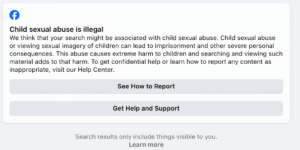
Error message from Facebook stating that child abuse is illegal with no search results. Pin

Your choices – Report abuse or a page that encourages you to get help to avoid abusing children. If you’re a kid who has been abused and want to connect with other survivors or read information about healing, etc.? You won’t get anything from a Facebook search. It’s blocked. Content that might talk about surviving child abuse is too dangerous, I guess.

This is why the idea that we can block access to content about abuse, LGBTQ information, mental health resources, etc., is going to end up making it harder for the people who need that information and need connection to get what they need.

I get it. The people who write these laws live in a world where kids all have a loving family who cares about them and want only to protect them from the evil that exists “out there.” They will provide whatever help and information their kids need, and there’s no need for them to navigate the wildness of the internet.  But we make information available to kids online because that’s not their reality. They don’t have supportive parents, they get kicked out for being gay, they are being abused at home, they are dealing with mental health issues their parents refuse to acknowledge, and they are often alone in trying to get help.

Those kids need an open internet. As a teen, I would have benefited from having an open internet, but it didn’t exist yet. So, I wrongly assumed child abuse was something only happening in my family and kept my mouth shut about it.

There are ways to protect kids. I wrote about them just yesterday. We enact rules that create fewer vulnerable kids. This isn’t the way.
Similar Posts

  • Recommendation

    If you ever get the chance to sit by a quiet lake, at sunset and just watch the fish, ducks, and a turtle swim around, while listening to the sounds of the water and the crickets, I highly recommend it! It’s a great way to clear your mind and simply let the world be for…

  • |

    Why I Took Part in the AFSP Virtual Overnight Event

    It was the stories. It was all of those people doing this in memory of someone they lost. Or, like me, in memory of the fact that we are still here instead of leaving others to tell our stories. In our day to day lives, it’s too easy to forget how many people are impacted by suicide each and every year across the country, and the world. The further in time I get away from that time in my own life, the easier it can be to put it behind me and forget about it. But, that is something I never want to do. As painful as it is, I want to remember what it was like to no longer want to be alive. When someone is in that place, I want to be able to say, “I’ve been where you are”, to recall all of the details, and be able to sit and understand. Because that is how we save people. Not by talking in hushed tones about depression, or mental illness, but by sharing the stories of people who survived and healed, and of those we’ve lost.

    Let’s face it, if you spend much time considering those losses, and listening to those stories, it is impossible to walk away without realizing that we have lost a devastating number of people to this disease. Many more than some of the diseases we all gladly talk openly about every day. Yet somehow, maybe because we don’t understand it, or are afraid of it, we keep silent. After all, it might make someone uncomfortable. Even I have, at times, kept the details to myself in fear of making other people uncomfortable, or risk having them worry about me. The more I read and heard these stories though, the more I realized that I needed to share my story, if only so that anyone who reads it would know, and maybe even understand a little bit, what it’s like to be so far down into the darkness of depression, that you don’t want to live any longer. So, with that said, let me share my experience with you, now that it’s been some 25 years, and maybe now people won’t worry so much about me. (Warning, this is about to get dark, and we will talk a bit about suicide, though I will keep those exact details out)

  • On-line predators

    I found this post about the statistics of on-line predators compared to the level of panic about on-line predators quite interesting. I’ve been aware for a number of years that focused media attention on any issue can greatly impact how people act, regardless of what the actual risk might be. How many people won’t travel…

  • Lauren Book on Fight, Flight, or Freeze

    Somehow, even though this is from 2016, I hadn’t seen it until last night. It’s a TEDx talk by survivor, and advocate Lauren Book. (https://laurenskids.org)

    In it. she shares her own story, and some words about going from victim, to advocate and how we can all advocate for children, but the part that really caught my attention was the beginning, and no not just because she uses an air horn. It’s the description of our responses to trauma, and how they are just part of us, mostly outside of our control, especially as children. Lauren’s freeze response wasn’t just a one-time event either, it went on for years, and was tied to thinking that all of it was her own fault.

    If this sound familiar, that’s because it is really common. We just don’t talk about it. We don’t talk about sexual abuse at all, and if we do, this kind of response is usually met with some nasty comments about why we waited to say anything. Those comments simply communicate that the person saying them, knows nothing about the brain and trauma response.

    Don’t be that person. Watch and learn a thing or two.

Leave a Reply

Your email address will not be published. Required fields are marked *

This site uses Akismet to reduce spam. Learn how your comment data is processed.

To respond on your own website, enter the URL of your response which should contain a link to this post's permalink URL. Your response will then appear (possibly after moderation) on this page. Want to update or remove your response? Update or delete your post and re-enter your post's URL again. (Find out more about Webmentions.)