
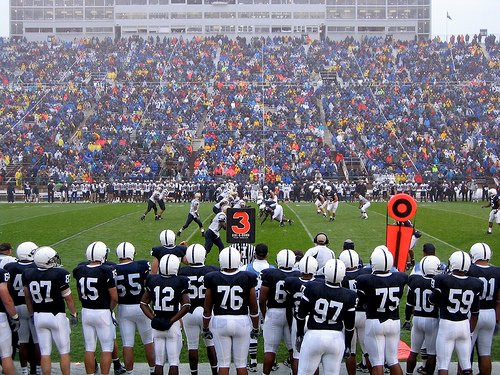
Penn State Still Struggling with Sandusky Story
The recent article in the Chronicle of Higher Education paints the picture pretty well, but what we are seeing this last week with the trial, and eventual conviction on a count of child endangerment of former University president Graham Spanier is an interesting example of something that I think is fairly typical.
On one side are those who were abused by Sandusky, and people who’s only real interest in Penn State came after this scandal broke. They have seen all that Sandusky was accused of, and seem convinced that not only Spanier, but everyone around the Penn State football program is guilty of a cover up, because how could they not know what was going on?
On the other, are people who were involved with the football program, and saw a well-respected assistance coach who had been involved in coaching for decades. How could they suspect, let alone know, what Sandusky was really like? Heck, I suspect even now some of them still have doubts about whether it’s really true.
Whenever I find myself reading about the two sides of something like this, a situation that I wasn’t personally involved in, I usually go with the old assumption that the truth is somewhere in the middle. While I do not know who knew what and what they should have known or anything like that in this case, I do think that many times when you have someone well-known and respected in the community accused of molesting children, this scenario is very likely to play out.
It’s easy for many of us outside of the situation to assume that people had to know. It’s easy for survivors to assume that someone else had to know. Both groups see Sandusky as a child molester, period. And he was.
But, he was also someone who worked with the University for decades. As a college football fan myself, I knew who Jerry Sandusky was, and I knew how respected he was. He and Joe Paterno were legends, they were part of the institution of Penn State football.
The reality is Jerry Sandusky is both of those things, and it’s precisely that reality that made it possible for him to do what he did. The stereotypical creepy old man that is often what we think of when we think of pedophiles, would have gotten caught. At the first hint of something going on, no one would have even questioned it. At Penn State, yes there were hints, I have no doubt about that. But it wasn’t some weird anti-social guy, this was Jerry. The guy they had worked besides for years and years.
It’s like someone coming to your house and saying “Hey, I think something weird is going on with your favorite uncle”. You’d like to think everyone would immediately take that to the authorities and have it investigated, but many of us simply wouldn’t. We’d question the source and have our doubts about it, because that’s not the person we know.
This is the struggle. How can we get past the assumption that we would know if someone was abusing kids and recognize that grooming happens not only to kids, but the the adults who are supposed to be protecting them? A pedophile doesn’t get to that many victims without being smooth, charismatic, and a respected part of the community. So blame the people in charge of Penn State for not recognizing the signs all you want, but don’t let this story pass without taking a minute to ask whether you would do the right thing for children if it’s someone you know and respect.
I hope you would.

